

The first six lessons, roughly.
- 01
Fast 3/4 timing and continuous rotation
- 02
Natural turn and reverse turn
- 03
Change steps between turns
- 04
Frame and posture for fast spinning
- 05
Floor navigation in tight spaces
- 06
How Viennese differs from American Waltz
Where you'll actually dance.
- Wedding receptions (grand entrances)
- Ballroom competitions and galas
About Viennese Waltz
Viennese Waltz is the original. Before there was an American Waltz, this was what people meant when they said “waltz.” It came out of the courts of Vienna in the late 1700s and stayed the dance of the Habsburg empire through the 1800s. The Strauss family — Johann Sr., Johann Jr., and Josef — wrote dozens of pieces in Viennese tempo that are still danced today. “Blue Danube.” “Tales from the Vienna Woods.” Most of what gets played at the Vienna New Year’s Day concerts.
Speed is the thing that separates Viennese from everything else. It runs at about 180 BPM, twice as fast as American Waltz. The 3/4 timing is the same, but everything happens at double pace. The result is a dance that feels like one continuous spin around the ballroom, broken only by the occasional change step when the lead wants to reset. Done well, the couple looks like they are floating in a small tight orbit while the room turns around them.
What it feels like to dance
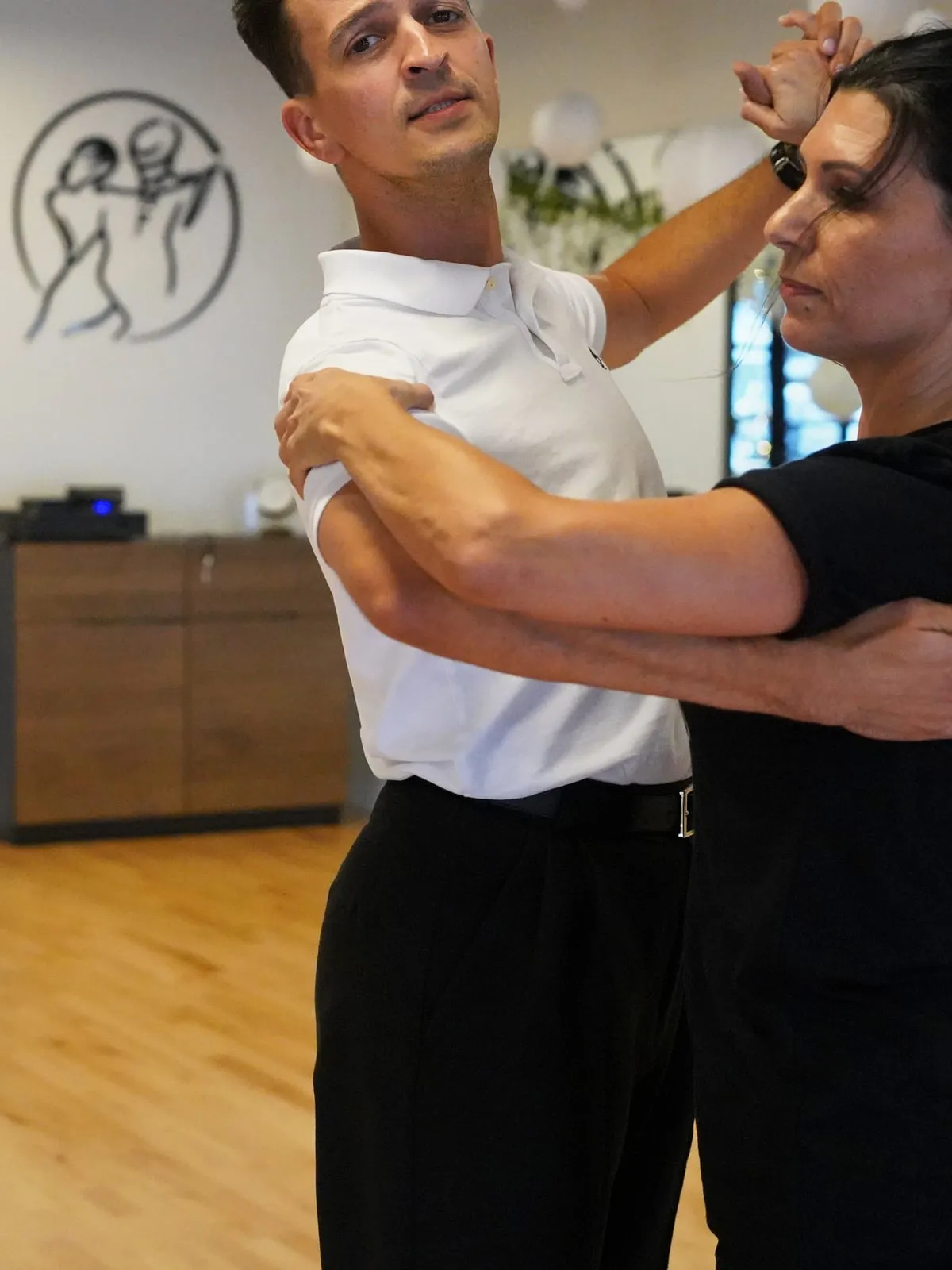
Viennese is dizzying at first. The basic figure is two bars of turning, one natural turn going right and one reverse turn going left, done back to back almost continuously. The first few lessons produce real vertigo. After a few weeks the inner ear adjusts and the rotation starts to feel like floating instead of falling. We have had students who could barely make it through one minute on the first try and were dancing full songs a month later.
Frame matters more here than in slower ballroom dances because there is no time to recover from bad posture. Shoulders stay over hips, weight stays forward, head turns slightly to look past the partner’s right shoulder. When the frame is right, Viennese feels effortless. When it collapses, the partners start fighting each other and the spinning becomes a lot of work.
Who it suits best
Viennese is for couples who already have a comfortable American Waltz and want the dramatic version. Most of the technique transfers, but the speed adds a level of difficulty that takes a few months to settle into. We do not recommend it as a first dance.
For wedding couples, Viennese is unmistakable. If your venue has a grand staircase, a long aisle, or a ceremony space that invites a sweeping entrance, this is the dance that fits. It is also what you want if your first-dance song is a Disney ballad in 3/4. “Beauty and the Beast,” “A Whole New World,” and quite a few others are in Viennese tempo even though most couples never count it out.
For older couples who grew up watching Hollywood films from the 30s and 40s, Viennese also reads as familiar. The dance has stayed visually consistent for two hundred years. It carries the same feel today that it did then.
Music & where to dance it
The Viennese playlist starts with Johann Strauss II and never really has to leave. “Blue Danube,” “Tales from the Vienna Woods,” “Emperor Waltz,” “Voices of Spring.” Beyond Strauss, modern arrangements of Disney ballads sit at Viennese tempo, as do faster Andrew Lloyd Webber pieces from Phantom of the Opera. Parts of the Lord of the Rings and Pirates of the Caribbean scores work too.
Viennese lives at wedding receptions, ballroom galas, formal events, and competition floors. Almost nobody dances it casually because the speed needs a partner you have actually practiced with. When it does fit the moment, it carries the room.
Faster, spinning, and unmistakably grand — the Viennese Waltz is what people picture when they hear 'a beautiful waltz.'
The first six lessons, roughly.
- 01
Fast 3/4 timing and continuous rotation
- 02
Natural turn and reverse turn
- 03
Change steps between turns
- 04
Frame and posture for fast spinning
- 05
Floor navigation in tight spaces
- 06
How Viennese differs from American Waltz
Where you'll actually dance.
- Wedding receptions (grand entrances)
- Ballroom competitions and galas
About Viennese Waltz
Viennese Waltz is the original. Before there was an American Waltz, this was what people meant when they said “waltz.” It came out of the courts of Vienna in the late 1700s and stayed the dance of the Habsburg empire through the 1800s. The Strauss family — Johann Sr., Johann Jr., and Josef — wrote dozens of pieces in Viennese tempo that are still danced today. “Blue Danube.” “Tales from the Vienna Woods.” Most of what gets played at the Vienna New Year’s Day concerts.
Speed is the thing that separates Viennese from everything else. It runs at about 180 BPM, twice as fast as American Waltz. The 3/4 timing is the same, but everything happens at double pace. The result is a dance that feels like one continuous spin around the ballroom, broken only by the occasional change step when the lead wants to reset. Done well, the couple looks like they are floating in a small tight orbit while the room turns around them.
What it feels like to dance
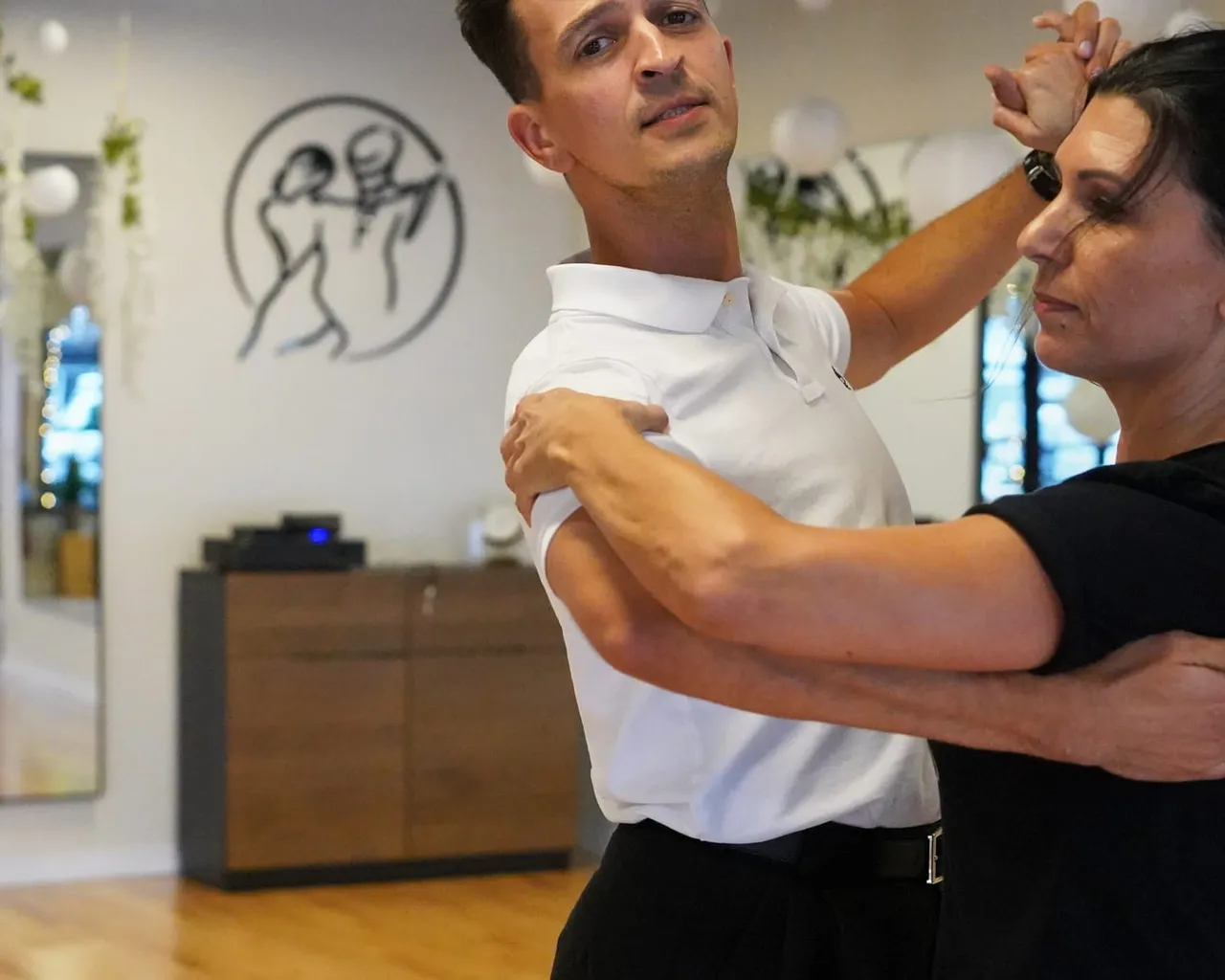
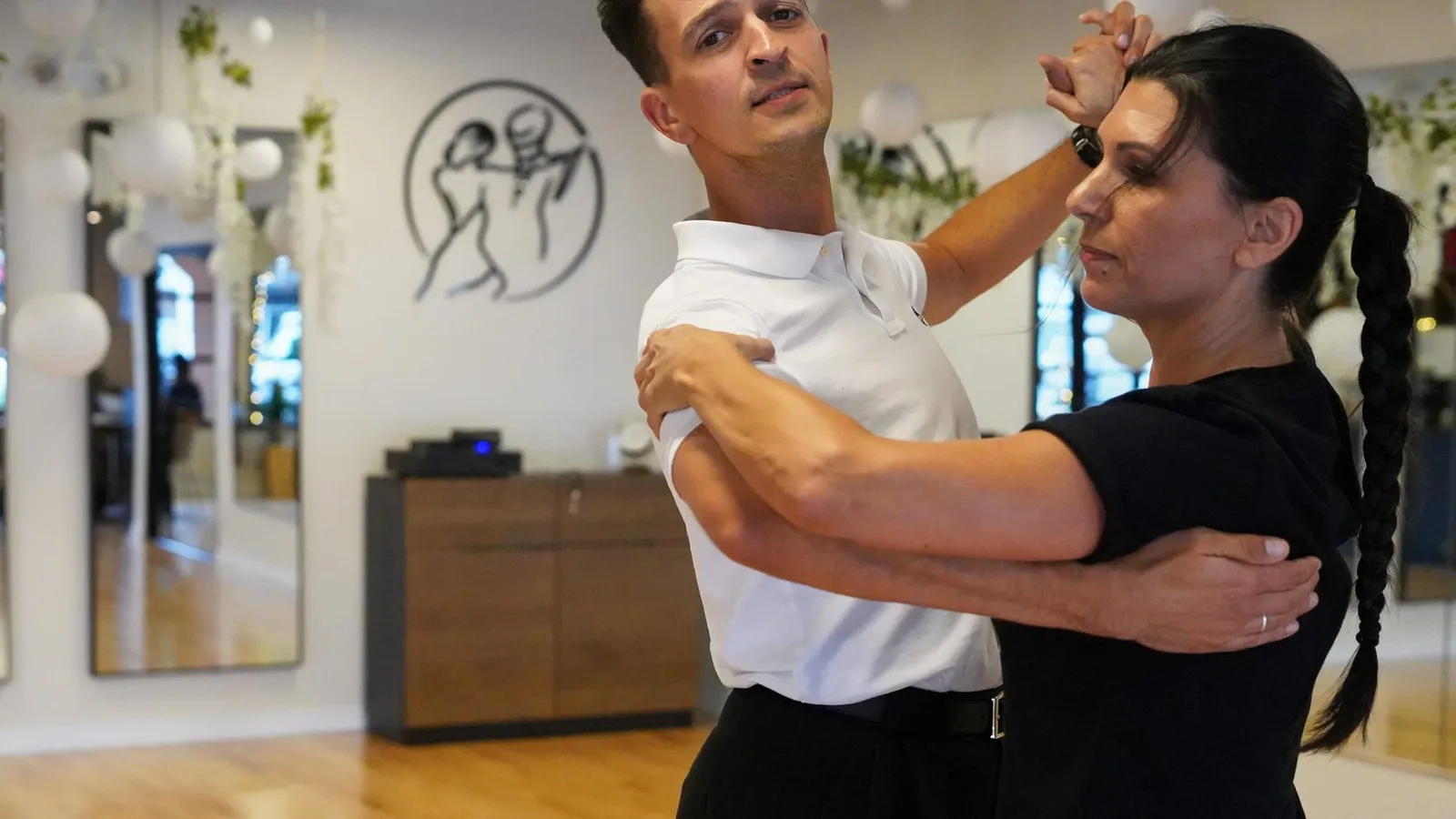
Viennese is dizzying at first. The basic figure is two bars of turning, one natural turn going right and one reverse turn going left, done back to back almost continuously. The first few lessons produce real vertigo. After a few weeks the inner ear adjusts and the rotation starts to feel like floating instead of falling. We have had students who could barely make it through one minute on the first try and were dancing full songs a month later.
Frame matters more here than in slower ballroom dances because there is no time to recover from bad posture. Shoulders stay over hips, weight stays forward, head turns slightly to look past the partner’s right shoulder. When the frame is right, Viennese feels effortless. When it collapses, the partners start fighting each other and the spinning becomes a lot of work.
Who it suits best
Viennese is for couples who already have a comfortable American Waltz and want the dramatic version. Most of the technique transfers, but the speed adds a level of difficulty that takes a few months to settle into. We do not recommend it as a first dance.
For wedding couples, Viennese is unmistakable. If your venue has a grand staircase, a long aisle, or a ceremony space that invites a sweeping entrance, this is the dance that fits. It is also what you want if your first-dance song is a Disney ballad in 3/4. “Beauty and the Beast,” “A Whole New World,” and quite a few others are in Viennese tempo even though most couples never count it out.
For older couples who grew up watching Hollywood films from the 30s and 40s, Viennese also reads as familiar. The dance has stayed visually consistent for two hundred years. It carries the same feel today that it did then.
Music & where to dance it
The Viennese playlist starts with Johann Strauss II and never really has to leave. “Blue Danube,” “Tales from the Vienna Woods,” “Emperor Waltz,” “Voices of Spring.” Beyond Strauss, modern arrangements of Disney ballads sit at Viennese tempo, as do faster Andrew Lloyd Webber pieces from Phantom of the Opera. Parts of the Lord of the Rings and Pirates of the Caribbean scores work too.
Viennese lives at wedding receptions, ballroom galas, formal events, and competition floors. Almost nobody dances it casually because the speed needs a partner you have actually practiced with. When it does fit the moment, it carries the room.
Viennese Waltz questions,
answered before you book.
Is the Viennese Waltz hard to learn?
What's the difference between Viennese Waltz and American Waltz?
I get dizzy spinning — can I still learn the Viennese Waltz?
How long does it take to learn the Viennese Waltz for our wedding?
Is the Viennese Waltz a good wedding first dance?
Do I need a partner to learn the Viennese Waltz?
Forty-five quiet minutes, just Viennese Waltz and the music.
Thank you!
We’ve got your message and we’ll be in touch shortly —
usually within a few hours.