
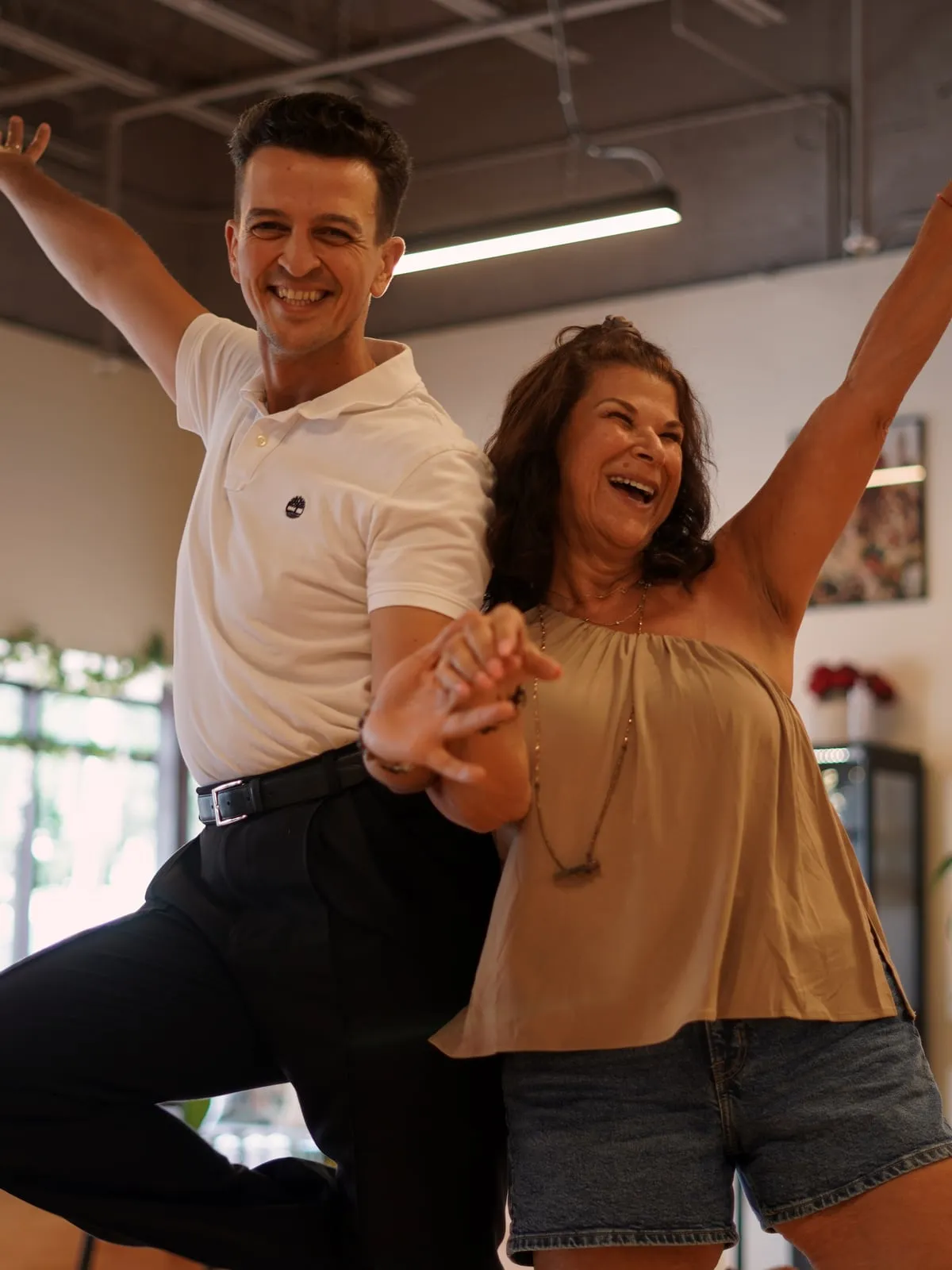

The first six lessons, roughly.
- 01
Basic 6-count rhythm and rock-step
- 02
Lead and follow connection in open hold
- 03
Underarm turns and pretzels
- 04
Triple-step footwork
- 05
Musicality — riding the swing rhythm
- 06
Adapting the basic to different songs and tempos
Variants you might explore, one at a time.
- East Coast Swing
The classic 6-count Swing — rock-step and two triple-steps. Danced to jazz, blues, and rock'n'roll. The most common Swing learned first.
- West Coast Swing
Smooth, danced in a slot, with a stretchy elastic connection. Set to contemporary R&B and pop, this is the modern competitive Swing form.
- Hustle
The disco-era 70s partner dance. Fast, spinny, danced to four-on-the-floor disco and modern dance music.
- Night Club Two Step
Slow-tempo Swing for ballads and slow pop. Sometimes called 'California Two Step.' Easy entry point and lovely for weddings.
Where you'll actually dance.
- Old School Square (Delray Beach — swing nights)
- South Florida West Coast Swing socials
About Swing
Swing covers a family of American partner dances that started in the 1920s and never really stopped evolving. The original Lindy Hop came out of Harlem’s Savoy Ballroom in the late 1920s. As the music shifted — from big-band jazz to rock’n’roll, then to disco, then to modern R&B and pop — the dance adapted. The result today is a handful of related styles that share a basic feel but suit different music and different moods.
At The Dance Circle, when someone asks for “Swing lessons,” we usually start by figuring out which Swing they mean, or which music they want to dance to. East Coast Swing is the default entry point because it works with the widest range of music and is the easiest to pick up. West Coast Swing is the modern competitive form, smoother and more nuanced. Hustle is the spinny, disco-era cousin. Night Club Two Step is the slow-ballad partner dance that almost no one knows by name, but that makes weddings dramatically easier.
People learn Swing for a lot of reasons. Some want a wedding first dance. Some grew up watching old movies and want to dance to Frank Sinatra. Some discovered West Coast Swing at a competition and got obsessed. Whichever door you came through, there is a Swing style that fits.
What it feels like to dance
The Swing family shares a rhythmic feel: a bouncy, syncopated quality where the second beat of each pair is slightly delayed. That is what “swing” means as a verb. Once you feel it in the music, your body wants to move that way.
East Coast Swing is fundamentally cheerful. Rock-step, triple, triple. Underarm turns, simple passes, room to play. West Coast Swing feels completely different — slower, with a long elastic connection in the arms, and the follow traveling back and forth in a “slot” while the lead stays mostly in place. Hustle is fast and circular, lots of spins, with the lead and follow trading places constantly. Night Club Two Step is almost a slow waltz feel, just walking with sway.
The lead-follow connection in Swing is usually in open hold (hands only, not closed embrace), which makes it more relaxed than Tango or close-hold Bachata. There is room to breathe.
Who it suits best
For couples, Swing is one of the most practical dances to learn. East Coast Swing works at almost any wedding playing music from the last seventy years. Night Club Two Step covers the slow songs. Between the two, you can dance most receptions and have a great time.
For singles, the Swing scene runs differently from Salsa. There are dedicated Swing socials and dances, plus a competitive West Coast Swing circuit that goes nationwide. The community is friendly and the etiquette is welcoming to newer dancers.
For wedding couples specifically, Swing is the dance we recommend most often when the song they have chosen is not naturally a waltz or a Foxtrot. If the song has any swing feel, Swing fits. If it doesn’t, we’ll point you toward Night Club Two Step instead. Either way, Swing material adapts to almost any tempo or mood.
Swing also works for people who have tried a more structured dance like Ballroom and found it too rigid. The improvisational element is closer to Salsa, but the music is broader. You can dance Swing to Sinatra, to Bruno Mars, to swing revival, to almost anything with a backbeat.
Music & where to dance it
For East Coast Swing, start with Frank Sinatra, Glenn Miller, Benny Goodman, and Ella Fitzgerald. Big Bad Voodoo Daddy and Cherry Poppin’ Daddies for the 90s swing revival. Postmodern Jukebox if you want modern pop songs rearranged in swing style. For West Coast Swing, the music is mostly contemporary R&B and pop — Bruno Mars, Adele, Ed Sheeran, John Mayer.
In Florida, the West Coast Swing scene has dedicated socials in Boca Raton, Miami, and Fort Lauderdale, plus regional events that pull dancers from across the state. East Coast Swing tends to show up at general partner-dance nights, retro events at venues like Old School Square in Delray Beach, and weekend dance parties at various studios.
From classic 6-count East Coast to the smooth slot of West Coast — the dances that built American social dancing.
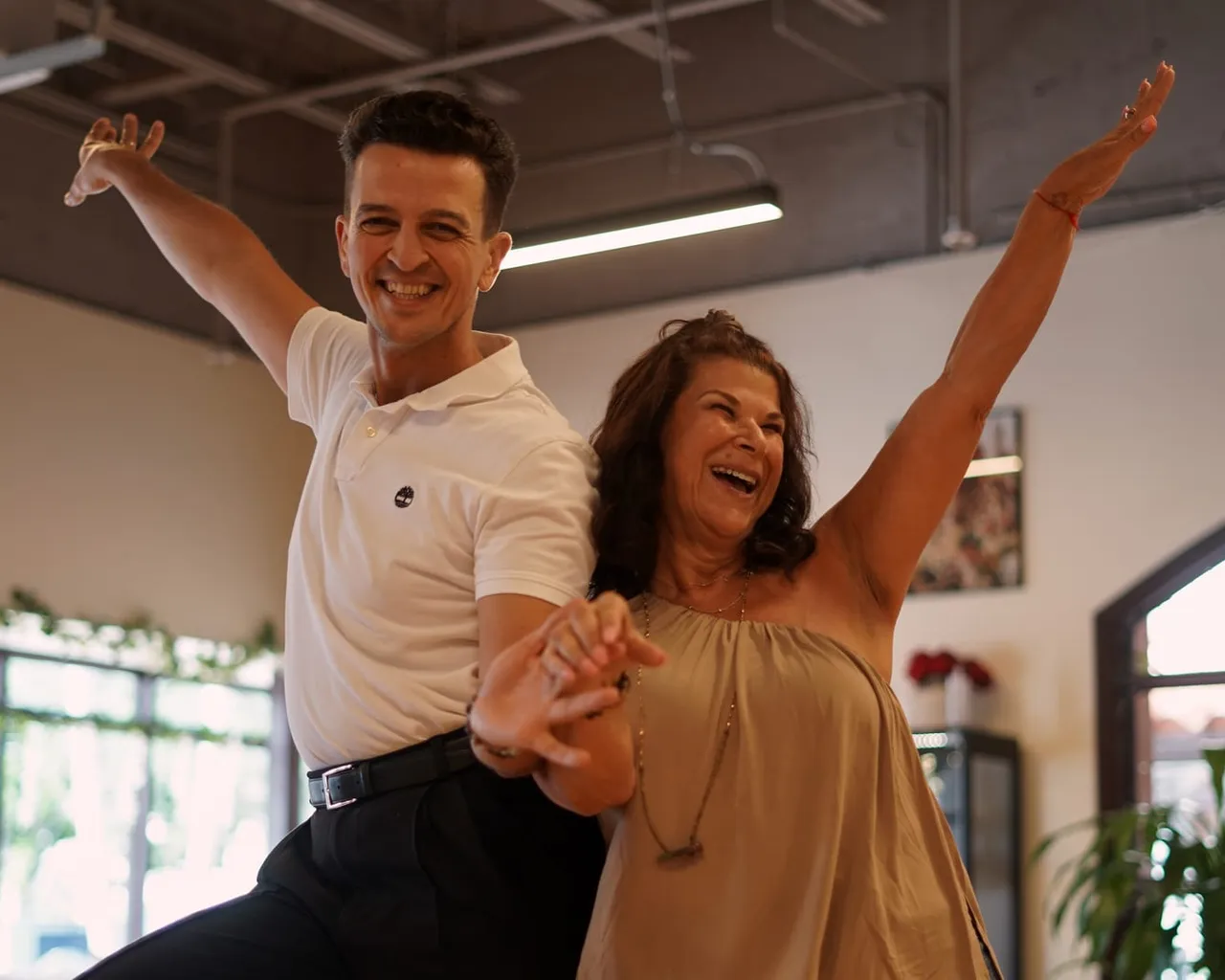
The first six lessons, roughly.
- 01
Basic 6-count rhythm and rock-step
- 02
Lead and follow connection in open hold
- 03
Underarm turns and pretzels
- 04
Triple-step footwork
- 05
Musicality — riding the swing rhythm
- 06
Adapting the basic to different songs and tempos
Variants you might explore, one at a time.
- East Coast Swing
The classic 6-count Swing — rock-step and two triple-steps. Danced to jazz, blues, and rock'n'roll. The most common Swing learned first.
- West Coast Swing
Smooth, danced in a slot, with a stretchy elastic connection. Set to contemporary R&B and pop, this is the modern competitive Swing form.
- Hustle
The disco-era 70s partner dance. Fast, spinny, danced to four-on-the-floor disco and modern dance music.
- Night Club Two Step
Slow-tempo Swing for ballads and slow pop. Sometimes called 'California Two Step.' Easy entry point and lovely for weddings.
Where you'll actually dance.
- Old School Square (Delray Beach — swing nights)
- South Florida West Coast Swing socials
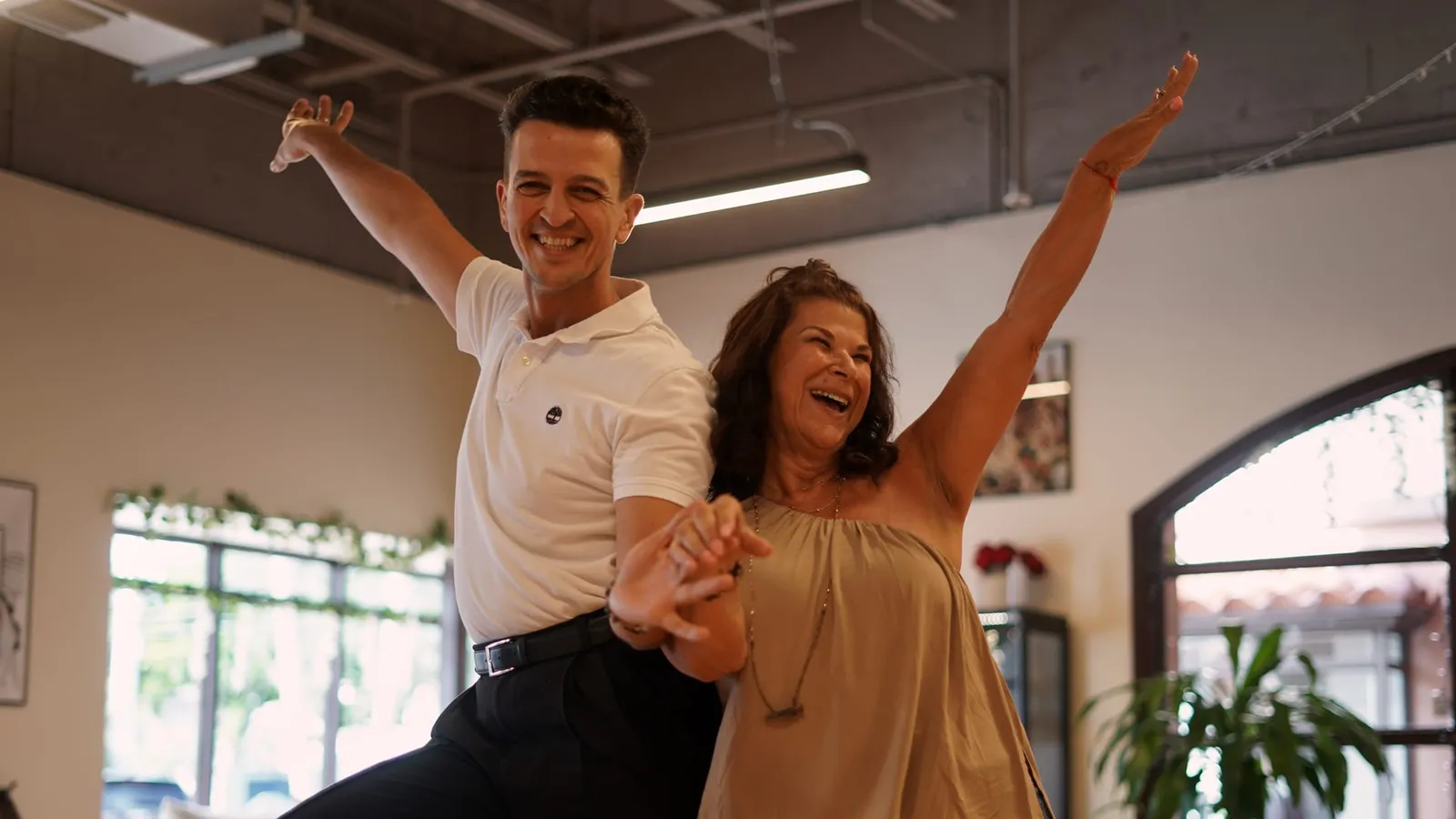
About Swing
Swing covers a family of American partner dances that started in the 1920s and never really stopped evolving. The original Lindy Hop came out of Harlem’s Savoy Ballroom in the late 1920s. As the music shifted — from big-band jazz to rock’n’roll, then to disco, then to modern R&B and pop — the dance adapted. The result today is a handful of related styles that share a basic feel but suit different music and different moods.
At The Dance Circle, when someone asks for “Swing lessons,” we usually start by figuring out which Swing they mean, or which music they want to dance to. East Coast Swing is the default entry point because it works with the widest range of music and is the easiest to pick up. West Coast Swing is the modern competitive form, smoother and more nuanced. Hustle is the spinny, disco-era cousin. Night Club Two Step is the slow-ballad partner dance that almost no one knows by name, but that makes weddings dramatically easier.
People learn Swing for a lot of reasons. Some want a wedding first dance. Some grew up watching old movies and want to dance to Frank Sinatra. Some discovered West Coast Swing at a competition and got obsessed. Whichever door you came through, there is a Swing style that fits.
What it feels like to dance
The Swing family shares a rhythmic feel: a bouncy, syncopated quality where the second beat of each pair is slightly delayed. That is what “swing” means as a verb. Once you feel it in the music, your body wants to move that way.
East Coast Swing is fundamentally cheerful. Rock-step, triple, triple. Underarm turns, simple passes, room to play. West Coast Swing feels completely different — slower, with a long elastic connection in the arms, and the follow traveling back and forth in a “slot” while the lead stays mostly in place. Hustle is fast and circular, lots of spins, with the lead and follow trading places constantly. Night Club Two Step is almost a slow waltz feel, just walking with sway.
The lead-follow connection in Swing is usually in open hold (hands only, not closed embrace), which makes it more relaxed than Tango or close-hold Bachata. There is room to breathe.
Who it suits best
For couples, Swing is one of the most practical dances to learn. East Coast Swing works at almost any wedding playing music from the last seventy years. Night Club Two Step covers the slow songs. Between the two, you can dance most receptions and have a great time.
For singles, the Swing scene runs differently from Salsa. There are dedicated Swing socials and dances, plus a competitive West Coast Swing circuit that goes nationwide. The community is friendly and the etiquette is welcoming to newer dancers.
For wedding couples specifically, Swing is the dance we recommend most often when the song they have chosen is not naturally a waltz or a Foxtrot. If the song has any swing feel, Swing fits. If it doesn’t, we’ll point you toward Night Club Two Step instead. Either way, Swing material adapts to almost any tempo or mood.
Swing also works for people who have tried a more structured dance like Ballroom and found it too rigid. The improvisational element is closer to Salsa, but the music is broader. You can dance Swing to Sinatra, to Bruno Mars, to swing revival, to almost anything with a backbeat.
Music & where to dance it
For East Coast Swing, start with Frank Sinatra, Glenn Miller, Benny Goodman, and Ella Fitzgerald. Big Bad Voodoo Daddy and Cherry Poppin’ Daddies for the 90s swing revival. Postmodern Jukebox if you want modern pop songs rearranged in swing style. For West Coast Swing, the music is mostly contemporary R&B and pop — Bruno Mars, Adele, Ed Sheeran, John Mayer.
In Florida, the West Coast Swing scene has dedicated socials in Boca Raton, Miami, and Fort Lauderdale, plus regional events that pull dancers from across the state. East Coast Swing tends to show up at general partner-dance nights, retro events at venues like Old School Square in Delray Beach, and weekend dance parties at various studios.
Swing questions,
answered before you book.
Is swing dance hard to learn for a beginner?
What's the difference between East Coast and West Coast Swing, and which should I learn first?
How long does it take to learn swing for a wedding first dance?
Do I need a partner to learn swing?
What should I wear and what shoes work for swing lessons?
Is swing dancing good exercise, and where can I dance it socially around Fort Lauderdale?
Forty-five quiet minutes, just Swing and the music.
Thank you!
We’ve got your message and we’ll be in touch shortly —
usually within a few hours.