

The first six lessons, roughly.
- 01
Samba bounce action (the signature pelvic movement)
- 02
Basic Samba step and Botafogo
- 03
Whisks, voltas, and corta jaca
- 04
Musicality with samba percussion
- 05
Connection in fast tempos
- 06
Solo Samba shines
Where you'll actually dance.
- Brazilian Day events (Miami)
- Latin ballroom socials
About Samba
Samba is Brazil’s national dance. It came together in the early 1900s in Rio de Janeiro, out of Afro-Brazilian musical traditions (lundu, maxixe) and the parade culture of Carnival. By the 1930s it was the soundtrack of Rio Carnival, with samba schools competing in massive choreographed parades down the Sambadrome. That tradition is still alive, and the parade version is the Samba most people picture.
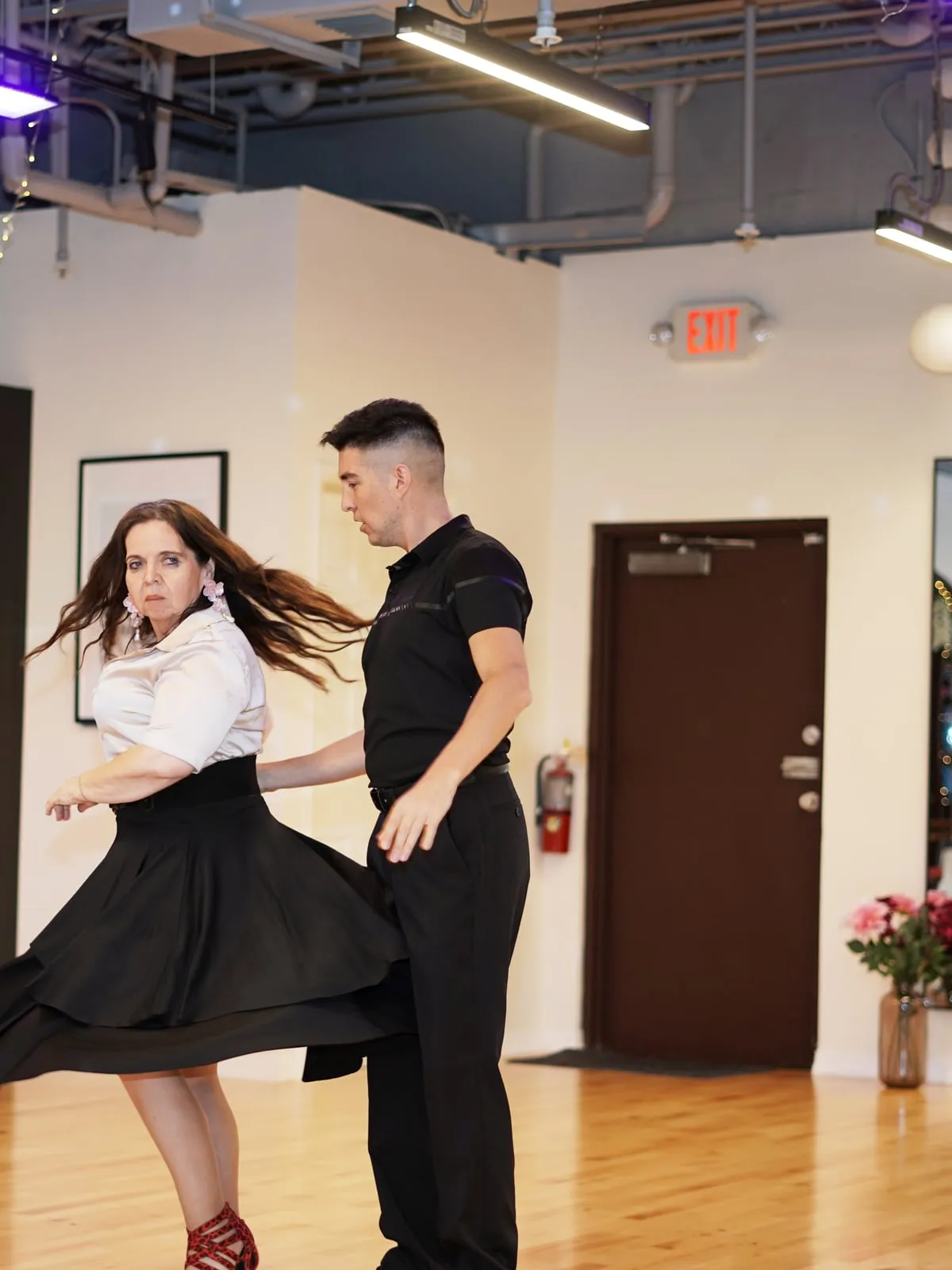
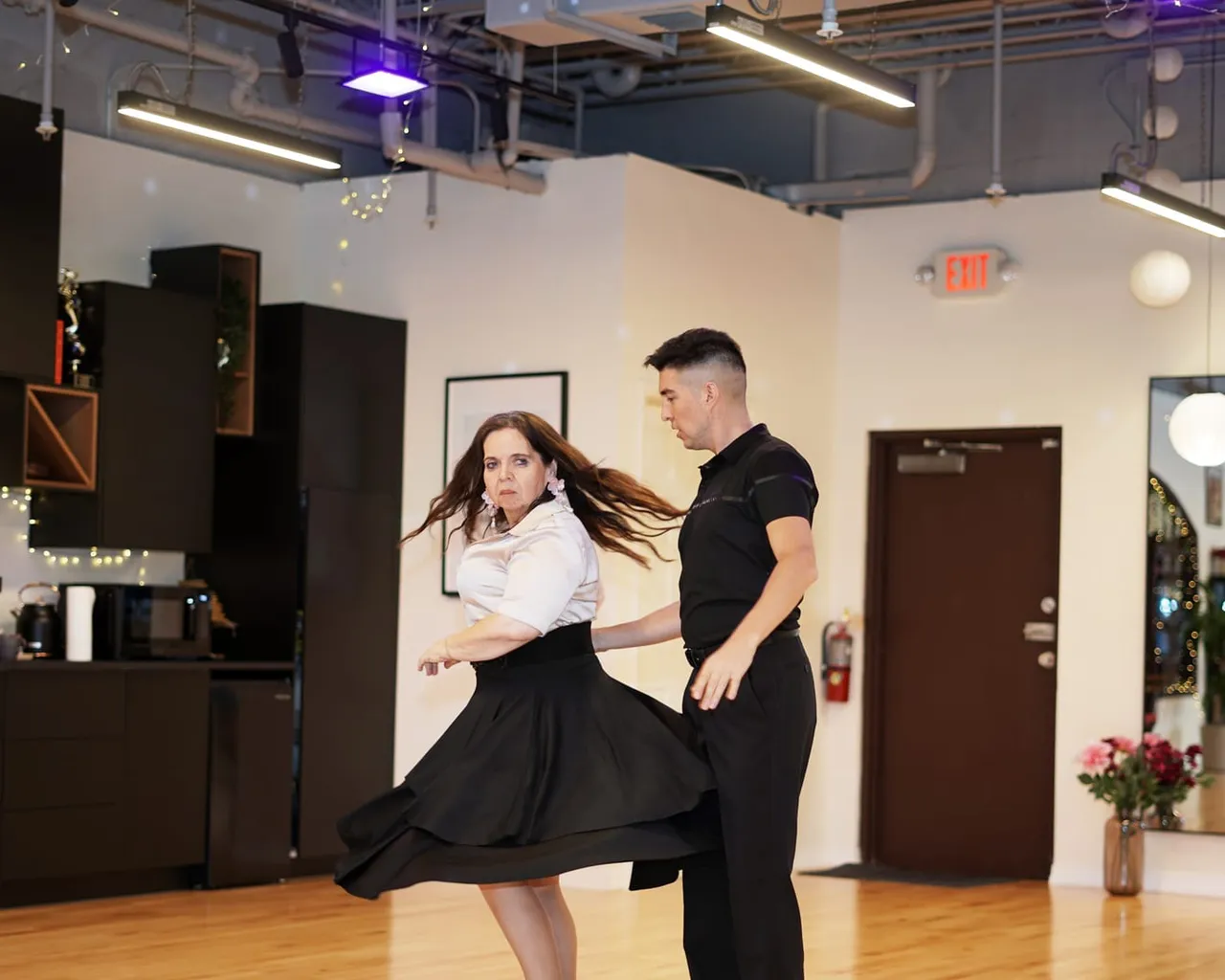
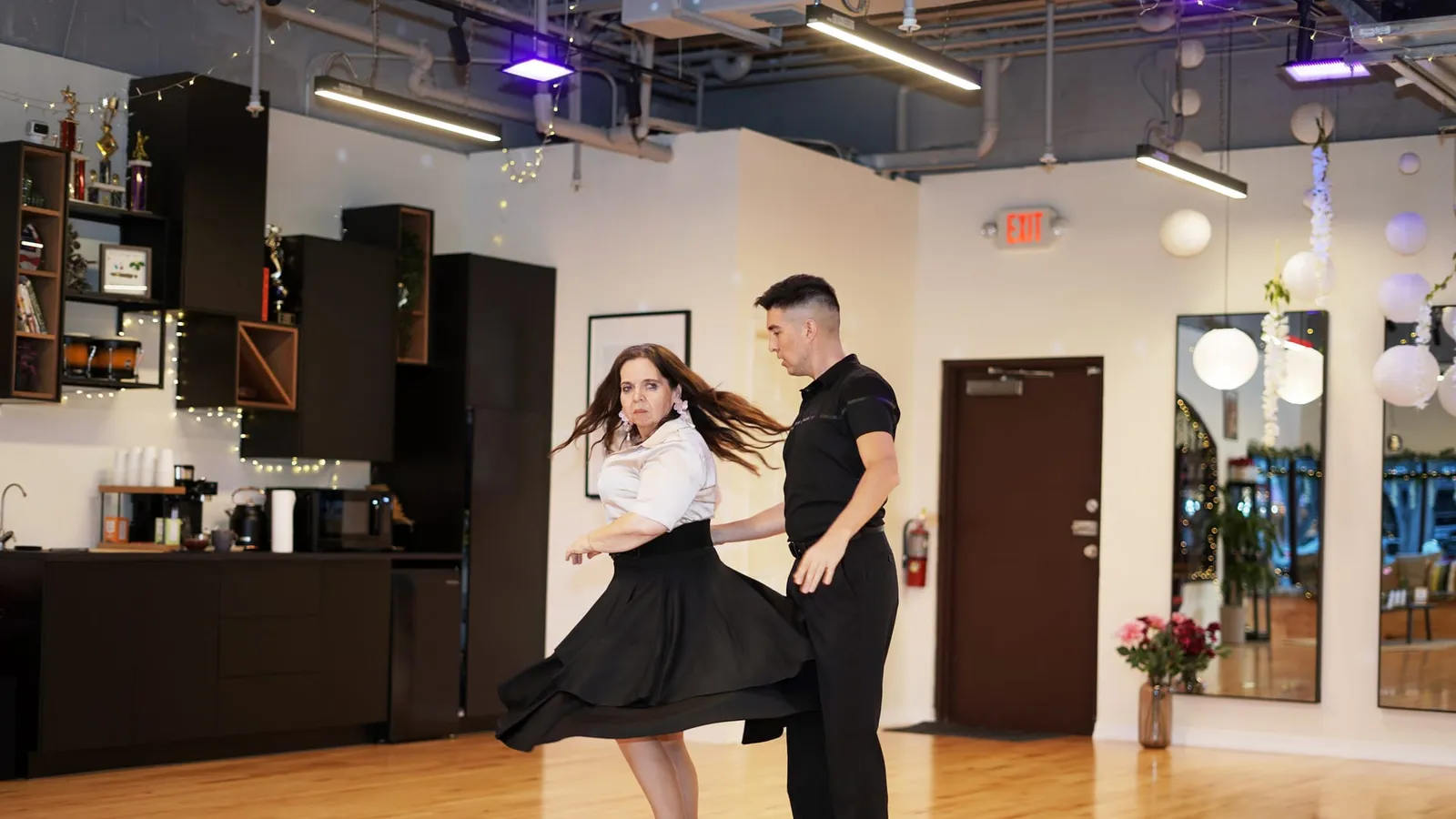
What we teach at the studio is ballroom Samba, which is a different thing. It is a partnered, choreographed version that was standardized for the international Latin syllabus in the middle of the twentieth century. It keeps the bouncy 2/4 rhythm and the pelvic action of the original, but builds a partner-dance structure around it. So it does not look like what you would see at Rio Carnival, but it reads as Samba immediately to anyone who knows the music.
What it feels like to dance
Samba is bouncy. The technique that defines it is the Samba bounce action, a controlled flex and straighten of the knees on every beat that produces a gentle vertical motion through the whole body. Without the bounce, Samba does not read as Samba. With it, every step has rhythm built in.
The hold is open or semi-closed, and the dance travels around the floor in small quick steps. Arms are softer than in other ballroom dances. There is also more solo footwork than in most partner dances: voltas (crossing side steps), botafogos (a forward-back rocking pattern), and shines where partners briefly separate to play with the music on their own.
Who it suits best
Samba is intermediate. The bounce takes some time to feel natural, and the basic pattern is more involved than Salsa or Merengue. We do not usually teach Samba as a first Latin dance. For students who already have Salsa or Cha Cha settled, it adds something distinctive that the other dances do not cover.
For couples who love Brazilian music, Samba is the obvious choice. Sergio Mendes, Jorge Ben Jor, and the faster Jobim recordings all come alive once you have a Samba basic. For showcase couples, Samba gives you a high-energy option that travels well across a floor and films well.
Music & where to dance it
Start with Sergio Mendes (the Brasil ‘66 era especially), Jorge Ben Jor, and Jobim’s faster material. For something more modern, Bebel Gilberto. If you want the percussion-driven version that really brings the bounce to life, Carnival recordings from Rio are the place to go.
In South Florida, Samba shows up at Brazilian Day events in Miami, at Latin ballroom socials that run the full Latin syllabus, and occasionally at Brazilian restaurants with live music. The dedicated Samba scene here is small compared to São Paulo or Rio. The music, on the other hand, is everywhere once you start listening for it.
The dance of Brazilian Carnival — bouncy, rhythmic, and unmistakably joyful. We teach the ballroom Samba style.
The first six lessons, roughly.
- 01
Samba bounce action (the signature pelvic movement)
- 02
Basic Samba step and Botafogo
- 03
Whisks, voltas, and corta jaca
- 04
Musicality with samba percussion
- 05
Connection in fast tempos
- 06
Solo Samba shines
Where you'll actually dance.
- Brazilian Day events (Miami)
- Latin ballroom socials
About Samba
Samba is Brazil’s national dance. It came together in the early 1900s in Rio de Janeiro, out of Afro-Brazilian musical traditions (lundu, maxixe) and the parade culture of Carnival. By the 1930s it was the soundtrack of Rio Carnival, with samba schools competing in massive choreographed parades down the Sambadrome. That tradition is still alive, and the parade version is the Samba most people picture.
What we teach at the studio is ballroom Samba, which is a different thing. It is a partnered, choreographed version that was standardized for the international Latin syllabus in the middle of the twentieth century. It keeps the bouncy 2/4 rhythm and the pelvic action of the original, but builds a partner-dance structure around it. So it does not look like what you would see at Rio Carnival, but it reads as Samba immediately to anyone who knows the music.
What it feels like to dance
Samba is bouncy. The technique that defines it is the Samba bounce action, a controlled flex and straighten of the knees on every beat that produces a gentle vertical motion through the whole body. Without the bounce, Samba does not read as Samba. With it, every step has rhythm built in.
The hold is open or semi-closed, and the dance travels around the floor in small quick steps. Arms are softer than in other ballroom dances. There is also more solo footwork than in most partner dances: voltas (crossing side steps), botafogos (a forward-back rocking pattern), and shines where partners briefly separate to play with the music on their own.
Who it suits best
Samba is intermediate. The bounce takes some time to feel natural, and the basic pattern is more involved than Salsa or Merengue. We do not usually teach Samba as a first Latin dance. For students who already have Salsa or Cha Cha settled, it adds something distinctive that the other dances do not cover.
For couples who love Brazilian music, Samba is the obvious choice. Sergio Mendes, Jorge Ben Jor, and the faster Jobim recordings all come alive once you have a Samba basic. For showcase couples, Samba gives you a high-energy option that travels well across a floor and films well.
Music & where to dance it
Start with Sergio Mendes (the Brasil ‘66 era especially), Jorge Ben Jor, and Jobim’s faster material. For something more modern, Bebel Gilberto. If you want the percussion-driven version that really brings the bounce to life, Carnival recordings from Rio are the place to go.
In South Florida, Samba shows up at Brazilian Day events in Miami, at Latin ballroom socials that run the full Latin syllabus, and occasionally at Brazilian restaurants with live music. The dedicated Samba scene here is small compared to São Paulo or Rio. The music, on the other hand, is everywhere once you start listening for it.
Samba questions,
answered before you book.
How hard is samba to learn?
Why does ballroom samba look different from the samba at Rio Carnival?
Should I learn salsa or samba first?
How long does it take to learn samba?
Can I learn samba on my own, without a partner?
Is samba a good dance for a showcase or for Brazilian music?
Forty-five quiet minutes, just Samba and the music.
Thank you!
We’ve got your message and we’ll be in touch shortly —
usually within a few hours.