
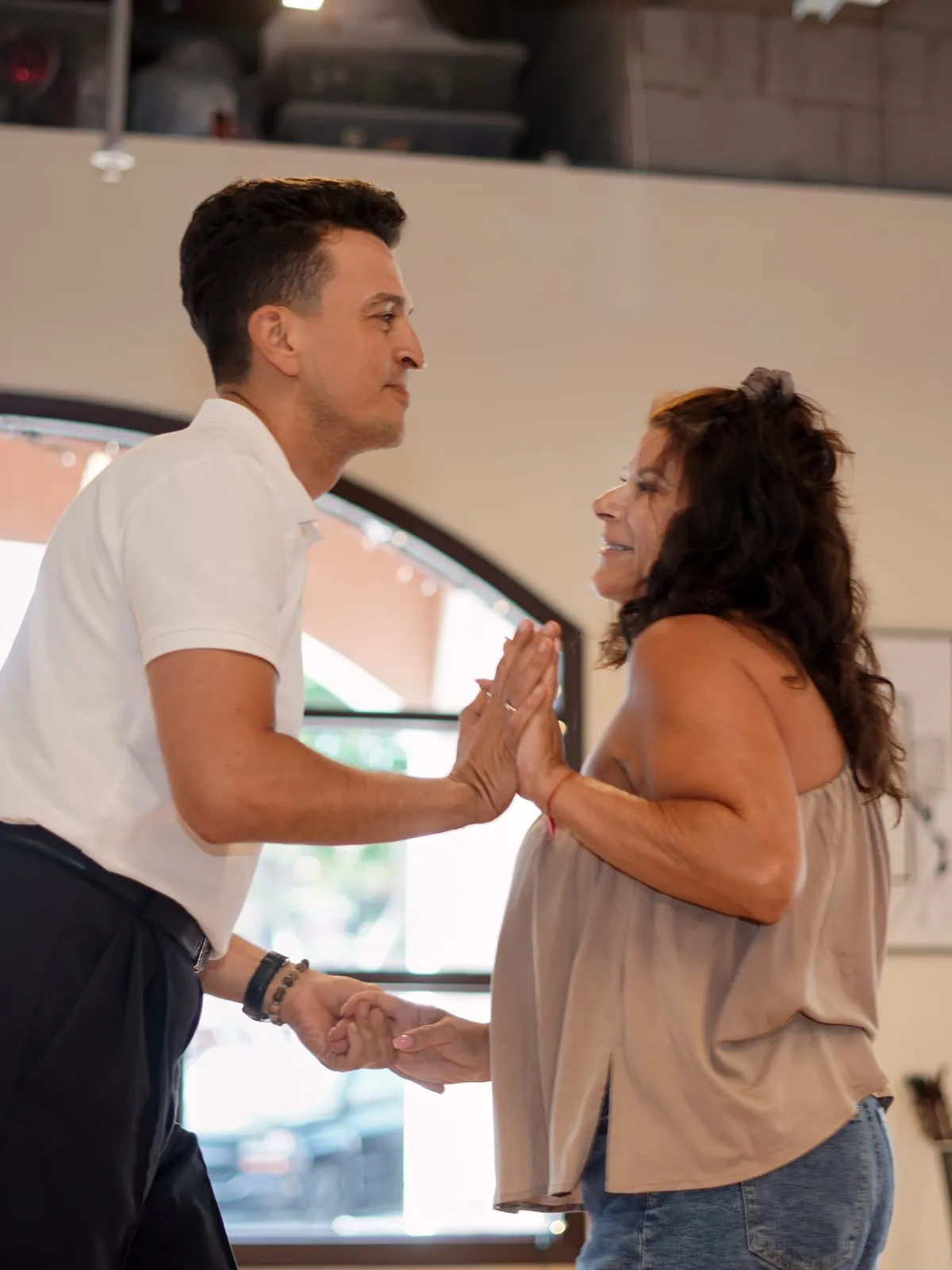

The first six lessons, roughly.
- 01
Basic chasse and the cha-cha-cha rhythm
- 02
Lead and follow in closed and open hold
- 03
Underarm turns and hand-to-hand
- 04
New York and spot turns
- 05
Hip motion and Cuban motion
- 06
Musicality across slower and faster cha cha tempos
Where you'll actually dance.
- Ball & Chain (Little Havana)
- Local ballroom socials
About Cha Cha
Cha Cha came out of Cuba in the early 1950s when composer Enrique Jorrín slowed a Mambo and added the distinctive triple-step that gives the dance its name. The “cha-cha-cha” you hear in the music is literally three quick steps in a row. Within a few years it had spread across Latin America and into American ballrooms, where it sits today as one of the five competitive Latin dances alongside Salsa, Rumba, Samba, and Paso Doble.
What makes Cha Cha distinctive in the Latin family is its playfulness. Rumba is romantic. Salsa is fiery. Bachata is intimate. Cha Cha is flirtatious. The rhythm has built-in pauses where dancers can play with attitude, hip motion, and eye contact. It’s the Latin dance most people describe as “fun” rather than “passionate,” which makes it a sensible entry point for couples who want some Latin flavor without committing to the intensity of Tango or the speed of Salsa.
What it feels like to dance
Cha Cha runs around 110-130 BPM. Faster than Rumba, slower than Salsa. The basic rhythm is “two, three, cha-cha-cha” — one slow step, another slow step, then three quick steps. Most beginners can feel the pattern in their first lesson, even before they have it clean.
The character of the dance lives in the hip motion. Latin hip motion is not a wiggle. It’s a result of bending and straightening your knees on every weight transfer, which makes the hips drop into the standing leg. When that’s working, the dance feels grounded and the upper body stays calm. When it’s not, the dance looks bouncy and tense. Most of what we teach in the first couple of months is the weight transfer that makes the hips happen on their own.
Who it suits best
Cha Cha is an excellent second Latin dance. People who have started with Salsa or Bachata tend to find it familiar enough to pick up quickly, but different enough to feel like progress. After a few months you can switch between Salsa and Cha Cha at the same social night, based on whatever the DJ plays.
For couples, Cha Cha fits the most events. Wedding receptions where the band plays a Latin set tend to land in Cha Cha territory. Cruise ship socials. Date nights at restaurants with live bands. The energy works for almost any context where you want to dance without it being heavy.
For singles, Cha Cha shows up alongside Salsa at most Latin nights in Miami and Fort Lauderdale. Same etiquette applies — you ask, you dance, you thank, you find the next partner. Songs are short (3-4 minutes), so you don’t get fatigued, and the playful character keeps the connection light.
Music & where to dance it
For the classic Cha Cha sound, start with Tito Puente and the rest of the New York Latin big band era. Eddie Palmieri brings the more rhythmic, percussive end. The Buena Vista Social Club recordings include some of the most beautiful traditional Cuban Cha Cha. Modern pop also gets adapted regularly. Santana’s “Smooth” is essentially a Cha Cha tempo, and Latin nights often slip pop crossovers into the rotation.
In South Florida, Cha Cha appears in most Salsa rotations. Ball & Chain in Little Havana mixes it into live band sets. Ballroom socials at local studios run dedicated Cha Cha tandas. Once you can hear the rhythm, you’ll start noticing it on the radio, in restaurants, and at events you wouldn’t expect.
The flirty, sharp Latin dance that pairs beautifully with Salsa nights and ballroom socials alike.
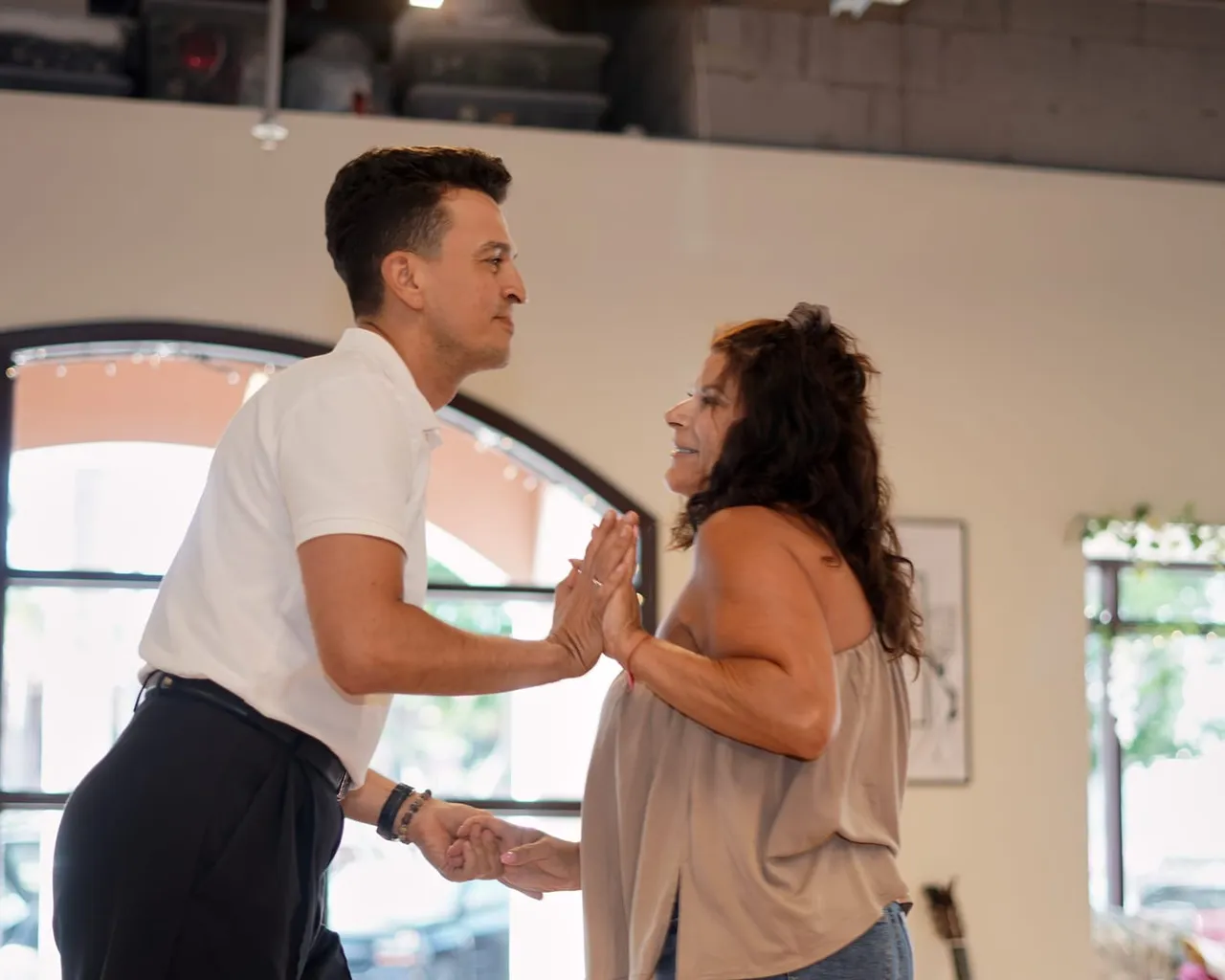
The first six lessons, roughly.
- 01
Basic chasse and the cha-cha-cha rhythm
- 02
Lead and follow in closed and open hold
- 03
Underarm turns and hand-to-hand
- 04
New York and spot turns
- 05
Hip motion and Cuban motion
- 06
Musicality across slower and faster cha cha tempos
Where you'll actually dance.
- Ball & Chain (Little Havana)
- Local ballroom socials
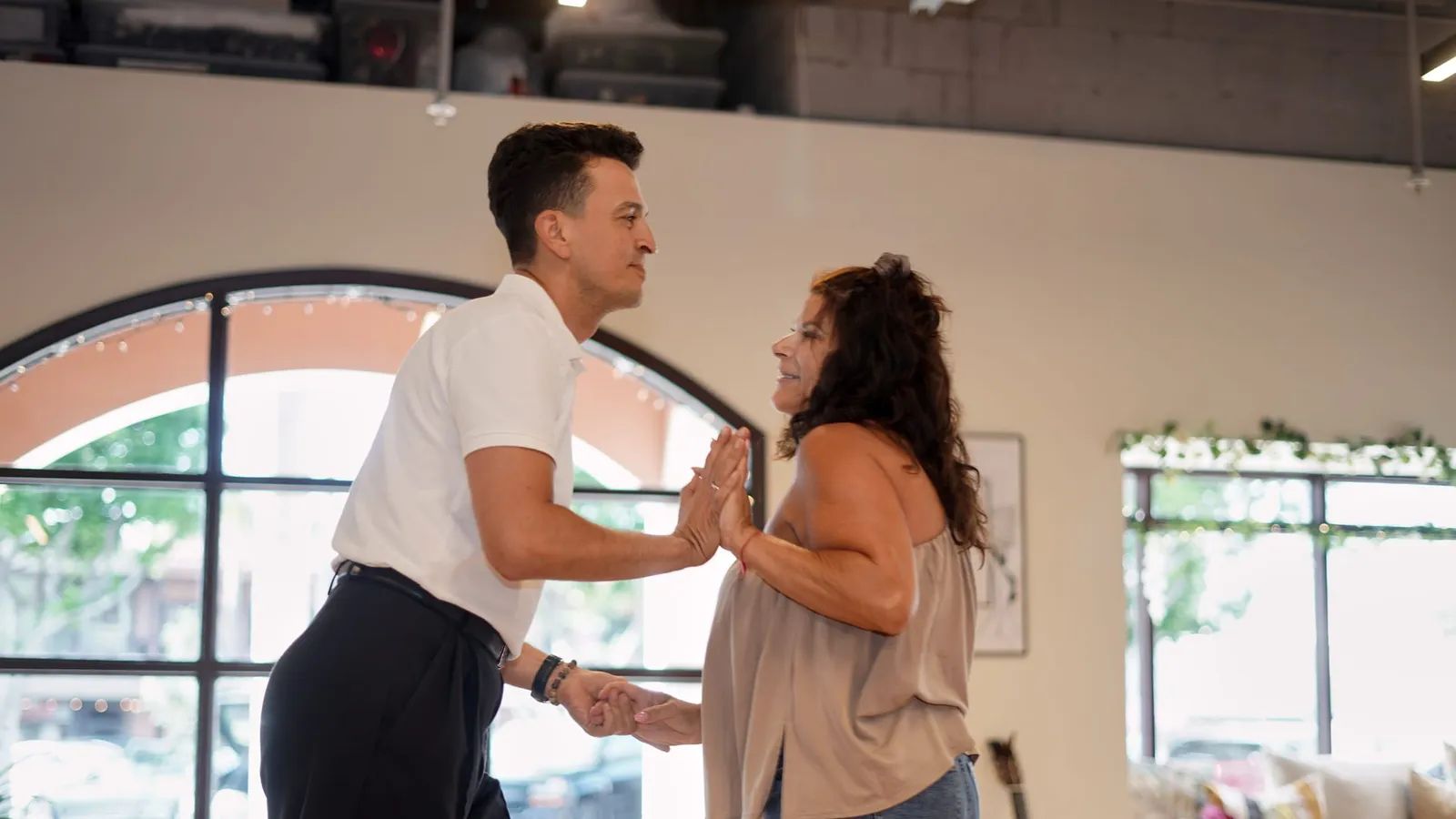
About Cha Cha
Cha Cha came out of Cuba in the early 1950s when composer Enrique Jorrín slowed a Mambo and added the distinctive triple-step that gives the dance its name. The “cha-cha-cha” you hear in the music is literally three quick steps in a row. Within a few years it had spread across Latin America and into American ballrooms, where it sits today as one of the five competitive Latin dances alongside Salsa, Rumba, Samba, and Paso Doble.
What makes Cha Cha distinctive in the Latin family is its playfulness. Rumba is romantic. Salsa is fiery. Bachata is intimate. Cha Cha is flirtatious. The rhythm has built-in pauses where dancers can play with attitude, hip motion, and eye contact. It’s the Latin dance most people describe as “fun” rather than “passionate,” which makes it a sensible entry point for couples who want some Latin flavor without committing to the intensity of Tango or the speed of Salsa.
What it feels like to dance
Cha Cha runs around 110-130 BPM. Faster than Rumba, slower than Salsa. The basic rhythm is “two, three, cha-cha-cha” — one slow step, another slow step, then three quick steps. Most beginners can feel the pattern in their first lesson, even before they have it clean.
The character of the dance lives in the hip motion. Latin hip motion is not a wiggle. It’s a result of bending and straightening your knees on every weight transfer, which makes the hips drop into the standing leg. When that’s working, the dance feels grounded and the upper body stays calm. When it’s not, the dance looks bouncy and tense. Most of what we teach in the first couple of months is the weight transfer that makes the hips happen on their own.
Who it suits best
Cha Cha is an excellent second Latin dance. People who have started with Salsa or Bachata tend to find it familiar enough to pick up quickly, but different enough to feel like progress. After a few months you can switch between Salsa and Cha Cha at the same social night, based on whatever the DJ plays.
For couples, Cha Cha fits the most events. Wedding receptions where the band plays a Latin set tend to land in Cha Cha territory. Cruise ship socials. Date nights at restaurants with live bands. The energy works for almost any context where you want to dance without it being heavy.
For singles, Cha Cha shows up alongside Salsa at most Latin nights in Miami and Fort Lauderdale. Same etiquette applies — you ask, you dance, you thank, you find the next partner. Songs are short (3-4 minutes), so you don’t get fatigued, and the playful character keeps the connection light.
Music & where to dance it
For the classic Cha Cha sound, start with Tito Puente and the rest of the New York Latin big band era. Eddie Palmieri brings the more rhythmic, percussive end. The Buena Vista Social Club recordings include some of the most beautiful traditional Cuban Cha Cha. Modern pop also gets adapted regularly. Santana’s “Smooth” is essentially a Cha Cha tempo, and Latin nights often slip pop crossovers into the rotation.
In South Florida, Cha Cha appears in most Salsa rotations. Ball & Chain in Little Havana mixes it into live band sets. Ballroom socials at local studios run dedicated Cha Cha tandas. Once you can hear the rhythm, you’ll start noticing it on the radio, in restaurants, and at events you wouldn’t expect.
Cha Cha questions,
answered before you book.
How hard is cha cha to learn for a complete beginner?
How long does it take to learn cha cha?
What's the difference between cha cha and salsa, and which should I learn first?
Cha cha vs rumba: aren't they basically the same Latin dance?
I don’t have a partner — can I still learn cha cha?
Is cha cha a good dance for a wedding or a cruise?
Forty-five quiet minutes, just Cha Cha and the music.
Thank you!
We’ve got your message and we’ll be in touch shortly —
usually within a few hours.