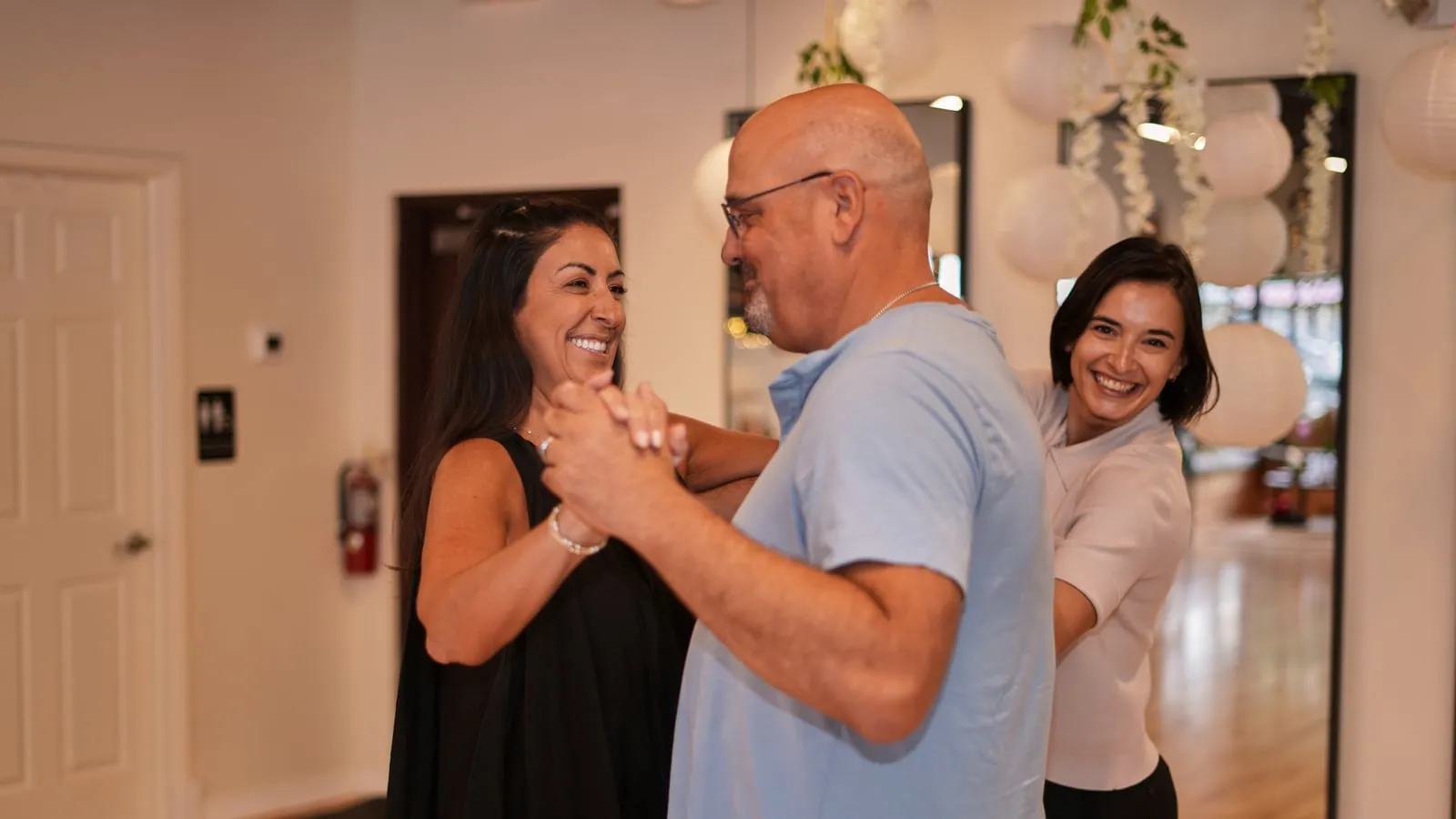
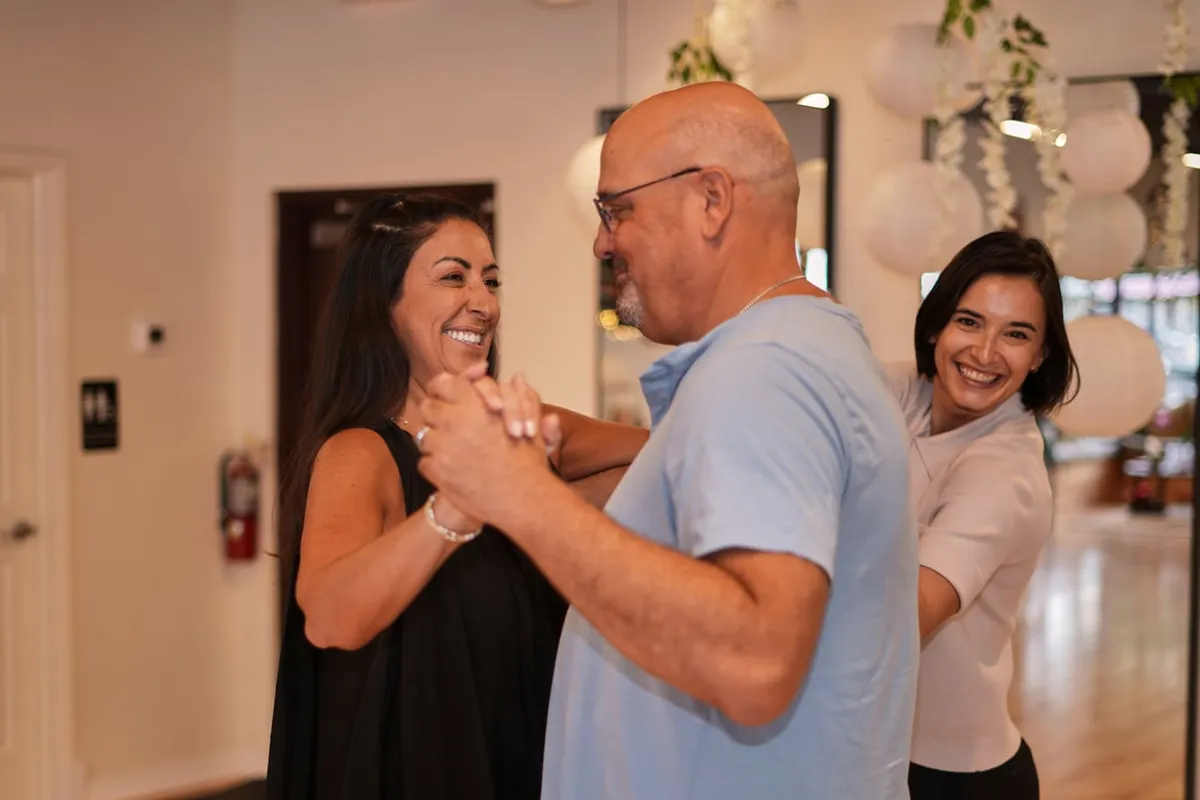

You’ve probably heard that staying active, staying social, and keeping your brain engaged are the three pillars of healthy aging. But what if there was one activity that checked all three boxes at once — and felt more like a Saturday night than a workout?
Ballroom dancing does exactly that. And the science backing it up is growing fast.
Move better, fall less, live more freely
One of the most well-documented benefits of ballroom dance is its profound impact on balance and motor control. A systematic review of 20 randomized controlled trials involving 723 participants with Parkinson’s disease found that dancers had measurably better motor outcomes and improved balance compared to non-dancers (BMC Geriatrics).
A separate meta-analysis of 16 RCTs confirmed that dance can significantly improve balance and reduce motor symptom severity in people with neurological conditions (PLOS ONE).
But you don’t need a diagnosis to benefit. Ballroom dancing forces your body to constantly adjust, shift weight, and coordinate movement — all of which train the systems responsible for stability. Over time, this translates to fewer stumbles, more confidence on your feet, and a lower risk of falls as you grow older.
A hobby that grows with you — not one you outgrow
Most fitness activities have an expiration date. Running gets harder on the joints. High-impact sports become risky. Even gym routines can feel tedious over time.
Ballroom dancing is different. It’s a skill you refine for life. The learning never stops. There’s always a new step, a new rhythm, a new partner to dance with. That continuous challenge is exactly what keeps both your body and brain sharp.
Research on people with multiple sclerosis found that participants who completed 10-week ballet-based dance programs showed improvements in balance, walking endurance, and even cognitive processing speed — all without any adverse events (Clinical Neurology and Neurosurgery). A related study on tango for MS patients showed significant improvements in mood, quality of life, and cognitive perception of deficits.
Dance adapts to your ability. You can start simple and add complexity as you grow stronger, more confident, more coordinated. It’s a hobby that meets you where you are and evolves with you.
The social connection factor
Let’s be honest: loneliness is one of the biggest health risks as we age. Isolation is linked to cognitive decline, depression, and even earlier mortality. Most exercise routines don’t solve this — you plug in your headphones and go.
Ballroom dancing solves it naturally. Every lesson is a shared experience. Every social dance is a conversation without words. You’re partnered, you’re laughing, you’re learning together. The community that forms around dance is unlike almost any other fitness activity.
Studies on dance for Parkinson’s patients highlight the importance of group-based physical activity, noting that the social environment contributes to improved mood and self-efficacy (Frontiers in Psychology).
Train your brain while moving your body
Dance is uniquely demanding on the brain. You’re not just moving — you’re remembering steps, counting rhythms, reading your partner, and adapting in real time. This combination of physical and cognitive challenge is exactly what brain-health researchers recommend.
A 2023 study on dance as complementary therapy for Parkinson’s disease found significant improvements not only in movement and balance, but also in executive function, cognitive flexibility, and inhibitory control (PLOS ONE). These are the mental skills that help you switch tasks, stay focused, and make decisions.
Researchers believe this happens because dance integrates sensorimotor processing, cognitive demands, and social interaction all at once — creating a uniquely powerful stimulus for the brain.
It’s never too late to start
One of the most encouraging findings: even a single dance class can produce measurable benefits. A 2025 study found that functional mobility improved after just one 60-minute dance session in people with Parkinson’s disease, compared to a control lecture group (PLOS ONE).
That means the barrier to entry isn’t your age, your fitness level, or your lack of experience. It’s just showing up.
Your future self will thank you
Ballroom dancing gives you something rare: an activity that’s physically beneficial, mentally stimulating, and deeply social — all at once. It’s not about being a great dancer. It’s about building a habit that serves your body, your mind, and your happiness for decades to come.
Whether you’re 30, 50, or 70, the best time to start dancing was yesterday. The second-best time is right now.
Ready to take your first step? Book a beginner-friendly intro lesson at The Dance Circle and discover what your future self has been waiting for.
Research cited
- BMC Geriatrics — Effect of dance on motor outcomes in Parkinson’s disease (systematic review)
- PLOS ONE — Dance for balance and motor symptoms in neurological conditions (meta-analysis)
- Clinical Neurology and Neurosurgery — Dance interventions for multiple sclerosis
- Frontiers in Psychology — Group-based physical activity and mood in Parkinson’s disease
- PLOS ONE — Dance as complementary therapy for Parkinson’s disease (2023)
- PLOS ONE — Functional mobility after a single dance session (2025)